
The difference between Merrimac Light and National Grid.
We’re dedicated to informing our customers of the benefits of public power versus investor-owned utilities, and one of the major benefits is the difference in cost.
We strive to provide the best possible customer service and electric service, and we’re committed to making long-term strategic investments to help keep costs down for our customers.
MMLD Strives to provide
- Friendly and helpful customer service
- An easy online payment option
- A robust website
- Cost saving and energy efficiency tips
- Communication
- Reliable daily service
- Timely return of service after an outage
- Low cost energy
- An engaging social media presence
- Community involvement and contributions
- Long-term strategic investment into future service
Bill Comparison
Compared to Merrimac Light, investor-owned utilities add extra fees and charges to your bill, and those additional charges add up!
Hover over the notations to learn more.

Residential B1:
The amount you pay for electricity used each month.
A flat fee to cover administrative expenses.
Power Purchase Agreement:
The PPA refers to a long-term electricity supply agreement between a power producer and Merrimac Light. The PPA may increase in warmer months to cover energy demand.
RCS Charge:
The Residential Conservation Services (RCS) charge is 20¢/month and aims at increasing the energy efficiency of homes in Merrimac.
Total Discount:
The total amount saved for paying before the discount due date.
Total Net:
This is the total amount due on your bill.
kWh Used:
This is the amount of electricity used for this billing period.
For this comparison we used bills that both have a usage of 505kWh.

Customer Charge:
A flat fee to cover administrative expenses.
Covers the cost of delivering electricity from substations to your home.
Transition Charge:
Designed to help National Grid recover costs associated with the restructuring of the electricity industry and the transition to a more competitive market.
Transmission Charge:
Covers the cost of transporting electricity from power plants to local distribution systems.
Energy Efficiency Charge:
Funds programs that promote energy efficiency and conservation.
Renewable Energy Charge:
Funds the state's renewable energy initiatives and programs.
Covers the costs associated with net metering, specifically the credits provided to customers who generate excess electricity and send it back to the grid.
Distributed Solar Charge:
Fee that helps recover costs associated with the Solar Massachusetts Renewable Target (SMART) Program, which aims to support the development of solar in the state.
Electric Vehicle Charge:
Fee that supports transportation electrification and related infrastructure development.
No Prompt Payment Discount:
National Grid does not offer a prompt payment discount.
Delivery Services Due:
The amount due for Delivery Services. The cost breakdown of each delivery service is outlined below.
National Grid's delivery services alone are more than the total due on the Merrimac bill!
Amount Due:
The amount due for the amount of electricity used for this billing period.
Paperless Discount:
Discount amount for enrolling in paperless billing.
kWh Used:
This is the amount of electricity used for this billing period.
For this comparison we used bills that both have a usage of 505kWh.
Total Delivery Services:
The total of the fees and charges due for this billing period.
National Grid's delivery services alone are more than the total due on the Merrimac bill!
Amount Due:
The total amount due for this bill.
Merrimac Light’s total bill is less than National Grid’s DELIVERY services alone!
Merrimac Light
Electric Usage: $48.08
+ PPA: $46.37
+ Customer Charge: $8.95
+ RCH Charge: $0.20
– Prompt Payment Discount: $4.81
National Grid
Electric Usage: $74.58
+ Customer Charge: $10.00
+ Distribution Charge: $45.14
– Transition Charge: $0.18
+ Transmission Charge: $29.28
+ Energy Efficiency Charge: $15.09
+ Renewable Energy Charge: $0.25
+ Net Metering Charge: $8.71
+ Distributed Solar Charge: $3.68
+ Electric Vehicle Charge: $0.36
– Paperless Discount: $0.49
$98.79
$186.42
Merrimac Light
Electric Usage: $48.08
+ PPA: $46.37
+ Customer Charge: $8.95
+ RCH Charge: $0.20
– Prompt Payment Discount: $4.81
$98.79
National Grid
Electric Usage: $74.58
+ Customer Charge: $10.00
+ Distribution Charge: $45.14
– Transition Charge: $0.18
+ Transmission Charge: $29.28
+ Energy Efficiency Charge: $15.09
+ Renewable Energy Charge: $0.25
+ Net Metering Charge: $8.71
+ Distributed Solar Charge: $3.68
+ Electric Vehicle Charge: $0.36
– Paperless Discount: $0.49
$186.42
Comparison Summary
Total Monthly Bill Costs
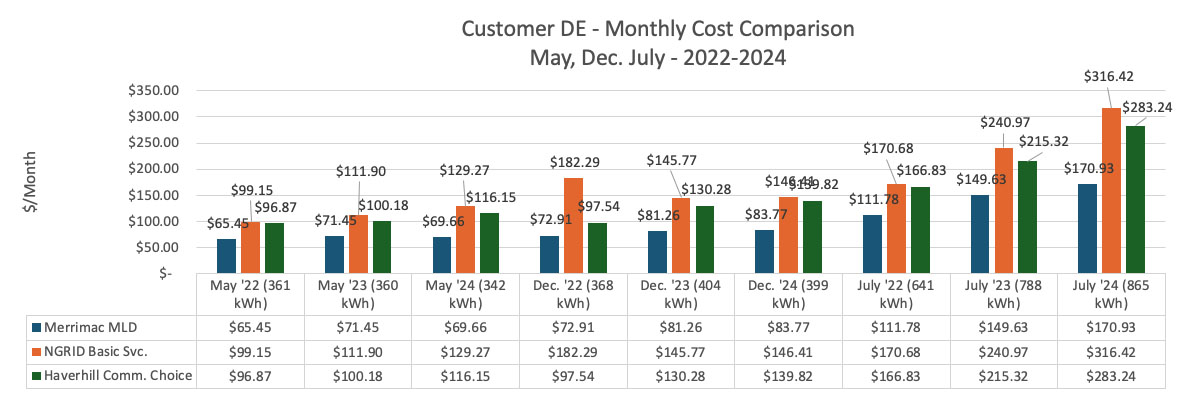
In every month analyzed – a total of 27 months, Merrimac monthly bill costs were significantly cheaper than either National Grid or customers participating in Haverhill Community Choice.
Total Costs Over 9 Months
In every 9 month period, the total Merrimac costs were significantly cheaper than either National Grid or Haverhill Community Choice customers. In general National Grid costs were over 75% higher than Merrimac and Haverhill Community Choice costs were over 50% higher than Merrimac.
Total Monthly Bill Cost Comparison
- Click on the charts for a larger view.
Low-Use Customers
Customers that use ≤ 600kWh
In this example, the customer averages 503kWh/month
Medium-Use Customers
Customers that use 600 – 1000kWh

This customer averages 748kWh/month
High-Use Customers
Customers that use ≥ 1000kWh

This customer averages 1089kWh/month
9-Month Cost Comparison
- Click on the charts for a larger view.
Low-Use Customers
Customers that use ≤ 600kWh

Medium-Use Customers
Customers that use 600 – 1000kWh

High-Use Customers
Customers that use ≥ 1000kWh
